
When Your Income Is Irregular: How Malaysians Can Plan with More Confidence
Key Takeaways
- Self-employed financial planning in Malaysia works differently from budgeting on a fixed salary. When you try to treat them the same way, things may start to fall apart.
- Oftentimes, the problem is not about insufficient earnings. It is in not having a structure to manage your irregular income well.
- Applying a three-bucket setup (one for daily expenses, one as a savings buffer, one for investment for the future) gives you the kind of financial stability a regular salary handles automatically.
- EPF i-Saraan and PRS are both designed for people without employment contributions, and both come with actual government incentives.
- Getting irregular income financial planning right is about building a strategy that can sustain you through the slower months.
Introduction
For many Malaysians, freelancing means not needing to adhere to a 9-to-6 working schedule and having more freedom to plan your day according to your preferences. However, while freelancing may offer the freedom that one seeks, the drawback is often not having a consistent income to supplement their lifestyle needs.
According to an article by Asia News Network, more than half of freelancers in Malaysia earn below RM1,500 a month, and 41.1% have no social protection under EPF or the Social Security Organisation (SOCSO).
If you freelance, run your own business, or do gig work, you already know the usual budgeting advice does not quite apply. Saving 20% of your income every month, setting aside money for investments, and contributing to EPF monthly is easier when you know how much money is coming in monthly. However, money management becomes much tougher when your income fluctuates every month.
This article explores irregular income financial planning strategies that can be utilised by freelancers, entrepreneurs, and gig workers where monthly income is inconsistent.
Why Do Standard Budgeting Methods Fail When Income Is Variable?
When you have a salary, budgeting is easy. The same amount arrives every month; you can easily set a plan around it, and the whole thing runs on autopilot.
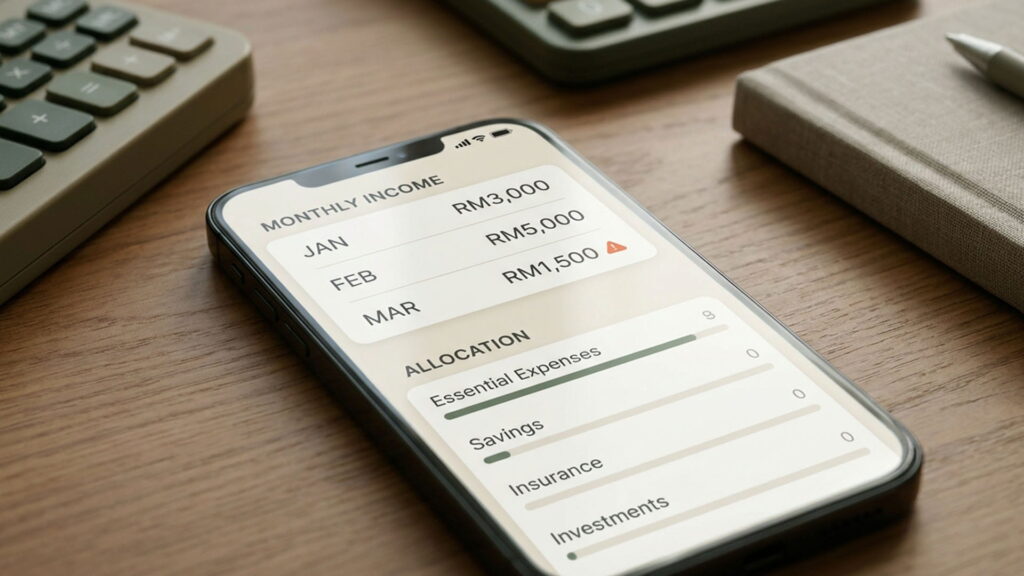
Managing your finances becomes much harder when your income is irregular. Imagine earning RM3,000 one month, RM5,000 the next, and RM1,500 the month after. More often than not, you’ll end up mismanaging your finances, spending freely in the good months and scrambling to make ends meet during the slow ones. What’s more, longer-term financial goals take a backseat – retirement savings get skipped, insurance premiums become optional, and investing becomes sporadic.
According to an article by Asia News Network, Malaysia’s self-employed workforce more than doubled between 2013 and 2025, with the biggest growth seen amongst individuals in their 20s. While irregular income makes budgeting in Malaysia harder to manage, it doesn’t necessarily mean that you cannot build a reliable, stable financial plan that works for you.
How Can You Build a Cash Flow System That Works?
The good news is that with the right strategies, you can still manage your finances well despite the unpredictable cash flow. Here are some core strategies that you can apply to make irregular income more manageable:
1) Prioritise the Essentials
First and foremost, make sure that your essential survival needs are covered. Keep track of monthly fixed expenses such as mortgage or rent, loans, debts, and bills. Then allocate a budget for variable expenses such as food, utilities, and petrol. Once you have this figure, you can move on to allocate money for non-essentials.
2) Build a Baseline Budget
Plan your monthly spending budget based on your lowest-earning month or a conservative average of your income in the past 6 to 12 months. This allows you to be more prepared when cashflow is low. You will be able to have a clearer picture of areas where you can save up or where you may be overspending without realising.
3) Create a Buffer Fund
During high-earning months, resist the urge to splurge or spend excessively. Instead, set aside a ‘buffer’ fund to function as an emergency fund to sustain you during months when income drops below your baseline monthly living cost. This doesn’t mean that you cannot treat yourself occasionally, but make sure to build this buffer first for your safety. The goal is to build 3 to 6 months’ worth of emergency funds to tide through the months when your income is leaner.
How Can Self-Employed Malaysians Save for Retirement?
Here is something a lot of people only realise after they go freelance: salaried employees get an additional 12% to 13% of their salary put into EPF by their employer every month. When you are self-employed, that disappears. It is one of the biggest gaps in self-employed financial planning in Malaysia when it comes to building a retirement fund.
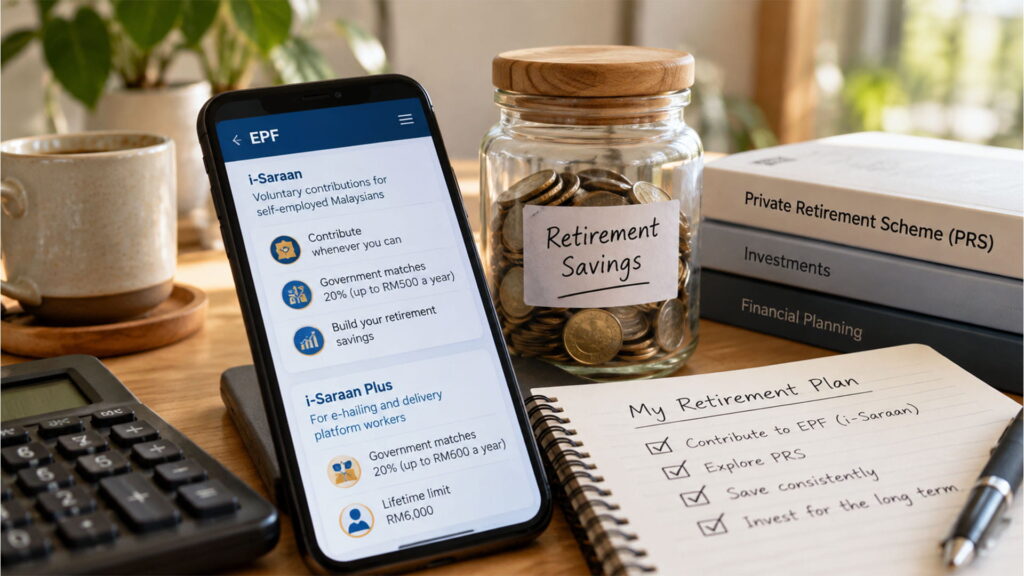
Fortunately, EPF provides you with an avenue to save for your retirement. i-Saraan is a voluntary EPF scheme built specifically for self-employed Malaysians: contribute whatever you can, whenever you can, and the government matches 20% of it (up to RM500 a year, or RM5,000 over your lifetime). Under Budget 2026, the i-Saraan Plus variant raised those caps to RM600 per year and RM6,000 lifetime for e-hailing and delivery platform workers.
Alternatively, private retirement schemes (PRS) are another investment instrument that can help you grow your retirement savings. PRS contributions are eligible for up to RM3,000 in annual tax relief every year, which serves as an added incentive to contribute when you have surplus. For a sense of how these contributions gradually add up, this piece on building toward RM1 million is worth a read.
Are You on Track With Your Finances as a Freelancer in Malaysia?
While freelancing offers greater flexibility and independence, it also means taking full responsibility for your own financial stability. Without a fixed monthly salary, employer EPF contributions, corporate insurance, or predictable benefits, it can be harder to know whether you are truly making progress towards achieving your long-term financial goals.
Being on track means looking beyond how much you earn each month and considering whether you are managing irregular income well, setting aside enough for monthly fixed expenses, having the funds needed when emergencies hit, and consistently building towards longer-term goals such as retirement and financial security.
Here are three questions to gauge whether you are on track financially:
- Do you have a buffer fund set up to tide you through slower months and for unexpected expenses? If not, start there.
- Are you contributing towards building your retirement fund? If you are not, then i-Saraan is a good option to start building your retirement savings.
- Do you know your monthly fixed expenses? Knowing how much you will need every month to cover your non-negotiables can help you manage your finances better, especially during high-earning months when the urge to splurge is high.
Having unpredictable income doesn’t mean that you should neglect investing and growing your wealth. This low-risk investment guide can help you identify investment instruments that suit your personal finance needs.

Frequently Asked Questions
1. How do I start financial planning for freelancers in Malaysia when my income changes every month?
Start by determining your monthly fixed expenses. These are survival essentials that you will need to commit to on a monthly basis. Once you know how much you need to spend every month for your essentials, set up a budget tracker based on low-income months to keep your expenses in check. Set aside surplus for your buffer fund and retirement fund.
2. Can self-employed Malaysians contribute to EPF for retirement?
Yes, through i-Saraan. Contribute any amount, any time, and earn the same EPF dividend rate as mandatory contributions. The government matches 20% of what you put in, up to RM500 per year or RM5,000 lifetime. The retirement planning page at Uno Advisers covers how to fit this into a proper plan when your income varies.
3. What is the most useful financial habit for someone with irregular income?
Whenever you receive your income, immediately set aside a portion to cover your fixed monthly expenses. If you have a surplus, set some aside for your buffer and emergency fund. If your buffer and emergency fund are already equivalent to 6 months or more of expenses, then invest that money for your retirement.
4. When does it make sense to get professional help with self-employed financial planning in Malaysia?
Self-employed income is rarely consistent; you may experience high-earning months, followed by dry spells. If you find yourself struggling to manage your cash flow, keep dipping into emergency funds, then it is time to engage professional financial planning help.
Managing money when income is unpredictable can be challenging because earnings fluctuate while living costs and expenses remain constant. However, by applying good self-employed financial planning strategies in Malaysia, you will be more equipped to handle the uncertainties that come your way. If you need help with your financial management, the Uno Advisers team is always ready to lend a hand.